2026 edition · originally submitted April 2019
The Unofficial Version
The CIA and State Department in Costa Rica, 1955. A BA thesis in Political Science at the University of Chicago, by Spencer Reed, republished with 2026 corrections and an afterword.
Download this edition (PDF) The unedited 2019 original (PDF) Jump to the 2026 afterword
A note on this edition
I wrote this thesis in 2018 and 2019, mostly from the CIA’s online FOIA reading room, State Department records and National Archives scans. The FOIA requests I filed then still produce mail from the CIA. Since spring 2026 I’ve gone back to the subject with far more documents: more than 150 CIA records, the relevant Foreign Relations of the United States volumes, OAS and UN records, and Costa Rican memoirs and archives.
The text below is the 2019 thesis. Shaded [2026 note]s mark the few points that the newer record, or a closer reading of the cited source, does not support. The afterword summarizes what the newer evidence shows.
Correction A: the Mustang pilots. Accounts conflict on who flew the four F-51s in combat. The thesis’s source, Toedt as quoted by Hagedorn in 2006, says that as far as he knew only the American pilots flew them. Ambassador Woodward’s 1997 account and the memoir of Costa Rican minister Jorge Rossi say Costa Rican commercial pilots, named as Guerra and Victory, flew the combat missions after a brief checkout. Hagedorn and Boyd (1991) say the US pilots flew patrols at first, gave several Costa Ricans cockpit checks and left. Woodward’s cable of January 15, 1955, reports that Costa Rican pilots were “confident 4 or 5 their number can operate them.” Later accounts allege a 1955 Mustang loss and identify its pilot as Costa Rican, but the documents examined do not establish that loss or the pilot’s identity. Toedt’s memoir says the Mustang he ferried in later “mysteriously crashed” while flown by a young Costa Rican captain, “some time after we, the U.S. pilots, had left,” and that DeLarm later admitted shooting it down. Hagedorn and Boyd (1991) also report a Costa Rican-flown Mustang lost, with its pilot killed. A fatal F-51 crash involving Captain Amado Conejo Solís is documented on January 22, 1956; no original aircraft serial yet connects it to the earlier claims. The CIA’s contemporaneous summaries of the 1955 air war record no Costa Rican loss.
The Unofficial Version: The CIA and State Department in Costa Rica, 1955
I. Abstract
This paper evaluates the role of the CIA and State Department on behalf of Nicaraguan-aligned rebels and Costa Rica, respectively, during the failed attempt to overthrow the Costa Rican government in January of 1955. It advances arguments for a higher level of CIA involvement on behalf of the rebels than has previously been recognized, possibly rising to the level of actual covert intervention, in addition to complicating the official story about US support of Costa Rica by presenting evidence demonstrating more intervention and greater knowledge of specific foreign intervention on the part of the State Department than has been officially acknowledged. These arguments, in addition to other new claims and evidence, are then evaluated in terms of the decision-making processes that may have produced them as understood through the lens of Allison’s Bureaucratic Politics model, and certain features of interest – particularly the decision of both parties to remain silent and even intentionally conceal key details about the conflict – are considered in the context of Carson’s collusive secrecy.
II. Acknowledgments
First, I would like to acknowledge my mother, Molly Darrell, who very generously spent a day traveling from her home in Baltimore to the National Archives in Silver Spring, MD, to scan dozens of State Department files on my behalf (in addition to her many years of patience and support, for which I also must thank my father, Bud Reed, and my sister, Rachel Reed). I am also grateful to my friend Zubair Merchant, without whose support during a particularly difficult finals week I would have been unable to complete the original version of what became this thesis. I am enormously appreciative of the advice and feedback of my BA Preceptors, Ray Noll and Onursal Erol, and of course I must extend my deepest thanks to my faculty adviser, Austin Carson, who has been an invaluable and endlessly patient resource throughout the entire process. Among other things, Dr. Carson was the source of the insight into the possible relevance of concern for a “reputation for covert action,” as he originally put it, which is a key component of my theoretical claims below. Finally, I am eternally grateful to Jack and Lyndon for their emotional support and general softness – they are wonderful cats.
III. Introduction
This paper discusses the attempted rebellion in Costa Rica in 1955, with a particular focus on the role of the United States (US) in the conflict. What was disguised as a rebellion was, in fact, a foreign intervention; the “rebels” were armed, trained, and supported by local state sponsors most notably including Nicaragua and Venezuela. This fact has been public knowledge almost since the conflict itself. Some elements of the State Department’s intervention on behalf of Costa Rica have also long been a matter of public record; its cooperation with the Organization of American States (OAS) to investigate the conflict followed by its decision to temporarily “sell” four F-51 planes to Costa Rica for $1.00 each were publicly acknowledged from the beginning. But important parts of the story of State Department intervention have so far remained untold, as has most of the involvement of the Central Intelligence Agency (CIA). This paper attempts to fill those gaps.
Using newly available archival sources, particularly from the CIA, in addition to expert analysis and witness accounts not previously included in the literature focused specifically on this conflict, I will demonstrate a higher level of CIA knowledge and de facto involvement with the Nicaraguan-aligned rebels than has previously been shown. Similarly, I will introduce complications to the official version of the State Department’s overt intervention on behalf of Costa Rica, arguing that the four planes temporarily sold to Costa Rica were almost certainly flown exclusively by American pilots throughout the conflict (contrary to the previously widely accepted claim that they were flown by Costa Rican pilots), and furthermore that one of the four planes appears to have been shot down – almost certainly by an American mercenary who often worked for the CIA, flying the same plane he had used during the CIA-orchestrated coup in Guatemala just a few months earlier. 2026 note: Accounts conflict on who flew the Mustangs in combat. Later accounts allege a 1955 loss, but the documents examined do not establish it or the pilot’s identity. A fatal F-51 crash is documented on January 22, 1956. See Correction A. These facts have never been officially acknowledged by the US or Costa Rican government.
In combination with the history of intervention, both covert and overt, of the CIA and State Department in the affairs of the relevant countries, this leaves us with several questions. First, what was the extent of CIA involvement? What firm evidence is there, and what else can we hypothesize on its basis? Second, what was the nature of State Department intervention on behalf of Costa Rica? Why was the destruction of a US plane kept secret? And, subject to the answers to those questions, what are we to make of a conflict in which the same state is apparently involved in supporting both sides? Through original research and a review of the existing literature, I will attempt to answer these and other related questions.
To understand the conflict, and the role of the US therein, I will discuss the case through the lens of bureaucratic politics, as one in which multiple bureaucracies engage in complex decision games followed by even more opaque action games. I will also consider the international dynamics at play, particularly relying upon the framework of collusive secrecy, the intentional concealment by one party of covert intervention by an opponent. I will examine the role of secret alliances, and more broadly the web of public and private and implicit and explicit commitments made between states, in shaping this conflict. Furthermore, I will suggest a new line of investigation: the role of perception and reputation in shaping state decisions regarding covert action, and specifically the ways in which the fear of developing a reputation for covert action might restrain a state or non-state actor from intervening in ways they might otherwise be inclined to do.
I will begin with a review of my research methodology (section IV), before conducting a literature review (section V) covering both theoretical and historical sources. I will then move on to a description of the historical background of the 1955 conflict (section VI), followed by a discussion of the new claims, arguments, and evidence I am introducing (section VII). Finally, I will discuss my findings in the context of the theoretical literature reviewed in section V (section VIII), conclude the paper (section IX), and provide a bibliography (section X).
IV. Methodology
This paper is based in large part on archival research. A large majority of the novel claims I advance are based on original research of previously unreleased or at least unexamined documents. This new research is chiefly drawn from the CIA Electronic Reading Room, an online archive of declassified CIA records.1 The CIA documents I examined fall into three major categories. These include intelligence analysis, operations documents, and big-picture analysis and reports.
The category of intelligence analysis includes the Central Intelligence Bulletin, a regular bulletin of updates from around the world circulated relatively widely within the upper echelons of the US government during the relevant time period. It also includes other intelligence reports, both for internal CIA use and circulation to other elements of the government.
Second is operations documents. Typically, these remain classified permanently, but there are rare exceptions to this rule. Outside of administrative mistakes, documents pertaining to CIA operations are only released if the operations have received official acknowledgment through disclosure by the executive. This is the case, however, in the CIA-directed coup in Guatemala, executed in June of 1954, just a few months before the events in question here. These documents are valuable for our investigation in two respects: first, they occasionally pertain directly to the events in Costa Rica, as in the case of a cable describing the disposition of several CIA planes used in the Guatemala coup, given as a reward to the governments involved in supporting that effort, and later used to support the “rebel” forces in Costa Rica. Second, these documents shed light on otherwise inaccessible elements of CIA operations and practices. Especially when paired with the sort of intelligence analyses available to us in the Costa Rica case, we can draw some intriguing conclusions regarding the manner in which the CIA presents and discusses its own actions, and what CIA interventions “look” like when our knowledge of them is confined to those other, more frequently declassified documents. Operations documents also include reports on intelligence gathering, like reports on coverage provided by the CIA’s Foreign Broadcast Information Service, tasked with recording and transcribing radio broadcasts and other public information sources.
Third, there are big-picture reports, like the previously top secret report on the CIB itself, which provided a window both into a specific and relevant event and into the general process by which the CIA intentionally conceals its own role in the events about which it has to provide more widely circulated reports.
My archival research also includes documents from the State Department. These documents include the communications between the State Department and the countries involved in the conflict, particularly Costa Rica and Nicaragua, during the period of crisis. They also include some documentation of internal deliberations and communications with other elements of the US government, in addition to the resulting actions taken by or on behalf of the State Department. The bulk of these documents come from the Foreign Relations of the United States series, a curated selection of State Department documents pertaining to particular regions and periods of history. Some were obtained in person at the National Archives in Silver Spring, MD, courtesy of my mother, Molly Darrell, who very generously took a trip from her home in Baltimore in order to scan and send dozens of State Department documents to me.
V. Literature Review
Within the field of international relations (IR), there is an extensive and growing body of literature on the process by which foreign policy decisions are made. There is also an expanding literature on the means and logic of covert action by states. The relevant literature in the former category is particularly that which deals with bureaucratic politics, while in the latter I draw most heavily on the new theoretical work of Austin Carson on covert action as a tool for the avoidance of escalation and the preservation of limited war and as an inspiration for a novel consideration of the role of reputations for covert action in shaping state decisions. I will also consider the role of alliances in shaping conflicts, and particularly the role of secret alliances and commitments in creating information asymmetries that might lower the threshold for conflict onset. Finally, there is the literature concerning this period of Costa Rican history and the conflict under consideration here.
Bureaucratic Politics and Organizational Processes
The field of bureaucratic politics was pioneered by Graham Allison in his seminal paper, “Conceptual Models and the Cuban Missile Crisis.”2 This became a similarly influential book, Essence of Decision,3 and also inspired a later article written with Morton Halperin focused on building out the framework of bureaucratic politics, “Bureaucratic Politics: A Paradigm and Some Policy Implications.”4 Motivating the project is the observation that, although foreign policy analysts up to that point had generally (if often only implicitly) analyzed decision making from a position positing rational and unified action (i.e., attempting to construct explanations for how a given action was rational from the perspective of state actors given their strategic objectives), this approach does not seem to adequately account for the actual processes by which decisions are made and actions result.
In response, Allison develops two alternative models, referred to as the Organizational Process Model and the Bureaucratic Politics Model, although he prefers the latter. Organizational process begins from the observation that the old model of unified, rational actors obfuscates the role of “various gears and levers in a highly differentiated decision-making structure,” and ignores the fact “that large acts are the consequences of innumerable and often conflicting smaller actions by individuals at various levels of bureaucratic organizations in the service of a variety of only partially compatible conceptions of national goals, organizational goals, and political objectives.”5 Accordingly, the organizational process model reframes what have traditionally been considered “‘acts’ and ‘choices’” as “outputs of large organizations functioning according to certain regular patterns of behavior.”6 These are often dependent upon an organization’s culture and standard operating procedures. In “Bureaucratic Politics: A Paradigm and Some Policy Implications,” this model is reframed as an organizational constraint upon the Bureaucratic Politics model, wherein the structure and nature of organizations shapes the information and options presented to leaders and then shapes the resulting action through “organizational routines.”7
The Bureaucratic Politics paradigm, meanwhile, “can be arranged as elements in the answers to three central questions: (1) Who plays? (2) What determines each player’s stand? (3) How are players’ stands aggregated to yield governmental decisions and actions?”8 Players include “senior players in the national security policy game … [including] major political figures, the heads of major national security organizations, including intelligence, [and] the military,” in addition to “junior players” such as members of Congress or the press.9 The second question brings to mind the famous line (often associated with the Bureaucratic Politics Model) that “where you stand depends on where you sit,” a good enough summary of the point – players’ goals are affected by their interests, “characterized under four headings: national security interests, organizational interests, domestic interests, and personal interests.”10 Finally, the aggregation of these stands typically occurs through “fixed rules … within an established channel for producing policies or decisions,” although “[i]n most cases … there are several possible channels through which an issue could be resolved,” and players also negotiate to push a decision into a channel likely to produce their desired outcome.11
Once a decision game has been played out, it leads to an action game, which generally occurs at a lower level than the original decision game, but often the original players will continue to maneuver to shape the implementation of the decision in a manner favorable to their interests.12 This structure is compatible with the point that players sometimes have the capacity to act independently, and may do so at their own initiative or through careful maneuvering within an action game, interpreting decisions as they so choose. Alex Mintz and Karl DeRouen cite Greg Cashman in making something like this point: in a decision game, “[t]he losing side might not accept its loss and attempt to prevail despite the reality of the decision. This can lead to fragmented decision making,” as when General Douglas MacArthur “made decisions that went against his civilian superiors in Washington during the Korean War” before being removed by President Truman.13
For our purposes, considering the case through the lens of bureaucratic politics can help us to make sense of apparently contradictory outcomes and decisions originating within the same government. Agencies like the CIA and State Department can have different and even conflicting interests and intentions. Sometimes these are resolved through decision games, but they can also persist and play out in the form of action games; even if, say, the CIA “lost” an internal negotiation, they might continue to pursue their own objectives nonetheless.
Collusive Secrecy and Covert Action
Austin Carson, in attempting to explain why the United States did not at any point publicly share the fact that it was engaged in a de facto air war with the Soviet Union during the Korean War (instead colluding in maintaining the fiction that their airborne enemies were anything but Soviet pilots flying Soviet planes on behalf of the Soviet Union), has recently developed a new paradigm for certain cases of covert action: collusive secrecy. His book, Secret Wars, argues “that escalation control and a shared desire to limit war can motivate covert intervention up front, collusion by major powers that detect it, and official non-acknowledgment if it is widely exposed.”14 “Covertness is defined as government-managed activity conducted with the intention of concealing the sponsor’s role and avoiding acknowledgment of it,” while “intervention is combat-related aid given by an outside state to a combatant in a local civil or interstate conflict that includes some role for personnel.”15 When one actor detects the covert intervention of another actor, they have
two basic options: collude or expose. Exposure involves publicly revealing evidence that a covert intervention is underway and/or publicly validating allegations by others. Collusion, in contrast, involves staying silent. There is an informational component of collusion; the detector must keep evidence of a covert intervention private rather than share it widely. There is also an acknowledgment component: a colluder must publicly deny or stay silent about allegations of a covert intervention made by others such as the media.16
We might assume that a state detecting covert intervention on the part of a rival would expose it (to reduce its chances of success, to trigger third-party sanctions, simply to embarrass a rival on the world stage), but there are good reasons for why they might choose not to do so. These reasons align with the logic of covert intervention itself: when the risk of escalation is “severe and control of escalation via the backstage is feasible, major powers will prioritize escalation control by embracing covertness and collusion.”17 These tools first allow states to reduce agitation for escalation on the part of domestic hawks, and second communicate simultaneously “resolve and restraint.”18 This dynamic is perhaps most clearly present in cases where the state intervening covertly has the option to do so in a way that would not be detectable by their enemy, but chooses to act covertly in a manner calculated to be not only observable but traceable by the enemy.
Collusive secrecy is a dynamic that could be present under some plausible versions of the case under discussion. Particularly if we assume a low level of CIA involvement on behalf of Nicaragua, the steps taken by the State Department to avoid identifying the intervention by foreign states against Costa Rica – such as their refusal to name any such states in the OAS report on the conflict, and their concealment of the fact that one of the temporarily Costa Rican planes was shot down – are clear examples of collusive secrecy. This framework also helps us begin to make sense of alternative scenarios outside of its scope; for instance, if the CIA was materially intervening and the State Department was aware of that fact, it seems that they would be doing something that can’t quite be described as a typical case of intra-state cooperation, nor is it exactly a case of Carson’s collusive secrecy, but something in between.
Finally, in thinking seriously about the dynamics and incentives involved in covert action, collusive secrecy (and in fact Carson himself) inspired the insight that we ought to consider the ways in which an agency like the CIA feels itself confined by its reputation. In this case, it was widely (and correctly) assumed that the CIA had been behind the very recent coup in nearby Guatemala. In internal documents, CIA analysts repeatedly claim that a successful overthrow of the Costa Rican government would be counter to US interests as it would presumably be blamed on the US. If this is their actual view of the situation, that implies first that they recognized they had already developed a reputation for covert intervention and that a) they felt that this reputation would lead other actors to assume, correctly or incorrectly, that they were behind any overthrow of the Costa Rican government and b) felt confined by this fact. Where they might have otherwise been sympathetic to the aims of the anti-Costa Rican rebels, their internal analysis claims they were actually opposed to their success due to the effects on the reputation of the CIA such an outcome might produce. We might expect this reputation to matter for at least two reasons: first, it would reflect poorly on the US government as a whole, which could itself lead to that state deciding to further constrain the CIA in order to minimize such an effect. Second, a reputation for covert actions – particularly ones that follow a very similar model – could be detrimental to the ongoing covert operations of the CIA or a similar agency. The more the CIA is seen as “behind” coups and other such events, the greater the barriers to their success. These barriers exist first on the operational level and second on the level of propaganda and perception, as of governments friendly to the US as CIA puppets.
Secret Alliances
Another relevant article is “Mutual Optimism as a Cause of Conflict: Secret Alliances and Conflict Onset.” In it, Muhammet Bas and Robert Schub begin from the “prominent international-relations theory … that mutual optimism, due to two sides holding divergent estimates of their relative bargaining power, causes interstate conflict.” They then “develop a theory of mutual optimism in which conflicting bargaining power estimates arise from asymmetric information about which, if any, third parties will join either side in a military dispute … [and] contend that secret alliances can generate mutual optimism, which increases the probability of conflict.”19 If one state has reason to believe it is likely to prevail in a conflict based on information not shared by the other, it will be less likely to compromise than it would be in the absence of that information. But because there is no corresponding increase in the willingness of its counterpart to compromise (as, after all, they do not know that piece of information), there is a lower probability of successful negotiation and a higher probability of either state initiating conflict in response.
Our case is a complicated one in relation to this theory, as it seems that both sides believed they had some level of commitment from the United States to either remain neutral or to actively support them, but we cannot be certain of the nature of or reasons behind those expectations. Although the two sides were not engaged in direct negotiation in the immediate run up to the 1955 conflict, and due to the covert nature of Nicaragua’s involvement in the conflict it is not quite so straightforward as in this paper, it seems plausibly to be the case that the expectation of US support shaped the behavior of both sides throughout the extended period of conflict that culminated in the 1955 rebellion and lowered the threshold for initiating hostilities.
Historical Literature
The literature on Costa Rica during this period is fairly extensive, although not without limitations. There is literature that places Costa Rica in an international context, most significantly The Sparrow and the Hawk: Costa Rica and the United States during the Rise of José Figueres,20 which analyzes the relationship between Costa Rica and the United States throughout this period; and Mark William Thomason’s master’s thesis, “Costa Rican-Nicaraguan Relations, 1948-1955: José Figueres versus Anastasio Somoza and Rafael Calderon,”21 which provides a thorough overview of the relationship between the two countries with an emphasis on the 1955 conflict. There is also literature on the life of perhaps the most important figure in Costa Rican politics, José Figueres, who played a pivotal role in all of the issues with which I am concerned; for this purpose, I primarily relied upon Don Pepe: A Political Biography of José Figueres of Costa Rica,22 written by Charles Ameringer, a friend of Figueres’ who was granted access to Figueres’ personal papers during the period of his life.
Cumulatively, this literature provides a wealth of resources, both in establishing historical facts and in considering their broader implications. One of the key limitations of this literature is that almost all of it is at least 20 years old, and much of it is substantially older. Outside of the theoretical developments we might assume have occurred in the interim, there is an additional, practical consideration: we now have greater access to formerly classified documents than was previously the case. One example of the sort of information that was not available to previous authors writing on this conflict specifically is another important source, Dan Hagedorn’s Latin American Air Wars and Aircraft, 1912-1969.23 As an aviation expert, Hagedorn provides first an expert analysis of questions pertaining to aviation (such as the possibility, or lack thereof, of the claim that it was Costa Rican pilots flying the four F-51s that were used to defend Costa Rica). He also provides information obtained through interviews of actors in our drama like Colonel Dell Toedt, who flew for the CIA in the Guatemalan coup and shortly thereafter showed up to fly the F-51s in defense of Costa Rica. Finally, Hagedorn cites at least one previously unknown State Department document, which establishes a higher level of State Department knowledge of foreign intervention than had previously been evident.
VI. Historical Background
In order to understand the 1955 conflict, we will begin with a brief overview of the relationship between Costa Rica and Nicaragua (and particularly Costa Rican President José Figueres Ferrer and Nicaraguan dictator Anastasio Somoza Garcia). We will then proceed to an overview of the conflict itself, emphasizing the public role of the State Department on behalf of Costa Rica. We will then consider the unacknowledged role of the State Department, drawing on newly unearthed documents and evidence not known to previous writers on the conflict. We will then move to the role of the CIA, the evidence for which is almost entirely drawn from my original research in the CIA archives.
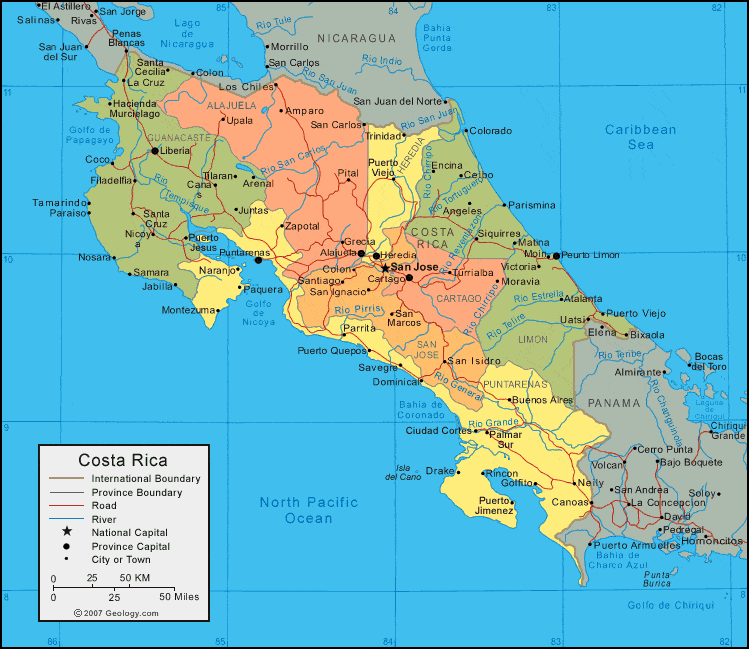
<https://geology.com/world/costa-rica-satellite-image.shtml>
Background
José Figueres first came to power through a violent revolution after the contested Costa Rican Presidential election of 1948. He ruled at the top of a military junta for about 19 months, during which he instituted wide-reaching social and political reforms (the expansion of education and social services, the nationalization of the banking industry, the inclusion in the franchise of women and black citizens) that culminated in the abolition of the Costa Rican army.24 Since that point, Costa Rica has had no army, only a relatively small federal police force which the CIA assessed as unable to “even patrol the country’s borders.”25 He then held a constitutional convention and democratic elections (after banning the Communist party), handed power to Otilio Ulate, the candidate whose apparent victory in the 1948 election had led to the attempt of the ruling party led by Ulate’s ally Rafael Ángel Calderón Guardia to remain in power, an event which prompted the revolution. After Ulate’s term, Figueres was elected as the next president in 1953, and when he did not push hard enough for a constitutional amendment that would have reduced the required period of interruption between presidential terms to four years, “the long-expected break between Figueres and Ulate occurred.”26 Ulate would return shortly thereafter, when Figueres alleged that he was conspiring with their one-time mutual enemy Calderón in organizing the attempted rebellion that is the central concern of this paper (a claim Ulate hotly contested, although Figueres was not alone in his belief – the State Department, at least, shared it27).
The 1948 revolution was not a purely internal affair. Much of the support, arms, and manpower involved came from the Caribbean Legion, a group of progressive and anti-authoritarian Latin American leaders which had been involved in a handful of conflicts in the previous few years. In order to obtain their support, Figueres had pitched a sort of domino theory of change: the Picado government in Costa Rica, Figueres had argued, was becoming increasingly anti-democratic and unpopular. It was vulnerable – the “weakest link,” as he put it – and once overthrown, Costa Rica could become a staging ground from which to overthrow the region’s other dictators.28 At the top of their list was Somoza, the dictator of Nicaragua.
1954 Conflicts
Somoza had risen to power through his position as the leader of the Guardia Nacional, a position he obtained through the support of the US Marine Corps, which was occupying the country at the time. He took power in 1936 and would remain there until his death in 1956. The hatred between Figueres and Somoza had grown from their ideological differences into something more like a personal vendetta, and Figueres wasted no time in moving against him once he returned to power in 1953. Almost immediately, members of the Caribbean Legion began to gather in San José. Officially, of course, this was without the knowledge of the Costa Rican government or Figueres himself (although apparently with the knowledge and support at least of Vice Minister of Public Security Humberto Pancheco Coto) – but it is more than a little suggestive that, when the San José police arrested some of its members over allegations that they were engaged in an arms trafficking conspiracy, they were “immediately released … to await a trial which never arrived.”29 The Legion acquired weapons from numerous sources, including, apparently, José Figueres.30 And when they set out on their ill-fated attempt to assassinate Somoza, it was in two trucks allegedly from the Figueres ranch (which he dubbed “La Lucha Sin Fin,” or “The Struggle Without End”).31 The mission was a failure: after attracting suspicion during preparation for their originally planned ambush, followed by an improvised ambush only rendered unsuccessful by the failure of their target to appear, the dejected legionnaires decided to regroup in Costa Rica. At this point, the mission became a disaster. On their way back, a Guardia Nacional truck attempted to pull them over, leading the Legion to begin a firefight. After killing one of the two soldiers in the truck as well as a policeman who had shown up by chance, the legionnaires realized more soldiers would be on their way and fled into the countryside. In short order, the Guardia Nacional had hunted down and killed most of them, taking a handful prisoner.32
Somoza was less than pleased with what he surmised to be Costa Rican involvement in the abortive attempt on his life. He expressed his displeasure via what would be called the Nicaraguan Note, sent by Foreign Minister Oscar Sevilla Sacasa to Costa Rican Foreign Minister Mario Esquivel on May 15, 1954, several weeks after the above had transpired. In it, Nicaragua accused Costa Rica (and Figueres himself) of complicity in the attempt, reminding Costa Rica that such complicity would constitute a gross violation of their 1949 Pact of Amity.33 The note went on to lodge two key demands: first, the expulsion and ongoing prohibition of Caribbean Legion members from Costa Rica; and second, improved border security to prevent arms trafficking and border crossings. It also said that, despite evidence of Figueres’ involvement, “Somoza would not push for punitive action against the president and he hoped the two brother republics could reestablish peaceful relations.”34
Although he had said he would not push for punitive action from others, Somoza had made no promise that he would not take such action himself. And indeed, in a precursor of things to come, on April 22, 1954 (about 3 weeks after the Caribbean Legion’s failed foray into Nicaragua), “a Nicaraguan fighter plane strafed the border town of Peñas Blancas.”35 Figueres took the hint. Having abolished the military during his period of junta rule (over fears that it would pose an internal threat to stable democratic rule), he suddenly found its absence opened the door to an external threat to stable democratic rule. Another reminder of this threat – and the fact that Somoza was not the only dictator in the area with a bone to pick with Figueres – came when Venezuelan dictator Pérez Jiménez, who had been rebuffed by the US State Department in his requests for the suspension of US support for Figueres, and had agreed not to attack Costa Rica (at least as long as Guatemala remained at risk of communist influence), sent planes to drop propaganda over Costa Rica depicting Figueres and his adviser (and former President of Venezuela) Rómulo Betancourt as homosexuals.36
Increasing State Department Involvement
Figueres recognized his vulnerability and took steps to alleviate it. He first asked the United States for arms, but had no means of purchasing them.37 He saw the opportunity he needed in his ongoing negotiations with the United Fruit Company (UFC). Figueres had been loudly threatening to either nationalize the company outright or take 50% of its profits. This seems to have been in part for the benefit of his constituents and in part a negotiating strategy, but the UFC (and the State Department which was beholden to its interests) was reluctant to take the risk. Ultimately, a contract was signed on June 4, 1954. Under the contract, Costa Rica would take 30% of the company’s profits, but the UFC would be able to pay workers below minimum wage and to import capital goods untaxed. Most importantly for the situation with Nicaragua, an implicit agreement was also reached that the UFC would pay one million dollars to cash-strapped Costa Rica as an advance on future taxes. This was the money that Figueres would use to purchase nearly half a million dollars’ worth of arms from the State Department.38 But, in a classic example of the security dilemma, this announcement threatened Somoza and Jiménez, increasing tensions and creating additional pressure on Figueres – all the more worrying to him as the military equipment would not arrive for months longer.
Adding to his concerns, in early July alarming new reports began to circulate that an invasion from Nicaragua was imminent. Previous authors have dated this report to July 9, the date on which US Ambassador to Costa Rica Robert Hill relayed them to the State Department,39 but the CIA had already incorporated the same report into its regular global intelligence bulletin by July 7, and that report claims the original intelligence was received by Ambassador Hill on July 3 – six full days before he apparently called it into Washington. 2026 note: The July 7 bulletin already reports Hill’s assessment, so his report had reached Washington by then.40 Once he did, however, the response was swift. Over the next 12 hours or so, numerous steps were taken in Washington. The Assistant Secretary of State for Inter-American Affairs convened a meeting with both countries’ ambassadors and negotiated a compromise including assurances of non-aggression from both parties and a promise that the arms Figueres had purchased from the United States a few months earlier would be delivered by July 14 (they had been “held up during Guatemala crisis,” so that they could be used as leverage “in order to be able to count on the support of the Costa Ricans at the then planned OAS consultative meeting on Guatemala”41).42 The State Department echoed almost exactly a concern frequently raised in CIA files, writing that the US interest in regional stability was in no small part due to concern over the “adverse world reaction from overthrow legitimately elected … Costa Rican Government, for which U.S. would be censured because of our … alleged role in recent change of government in Guatemala.”43
In early July, things appeared to be coming to a head: there were reports of an imminent Nicaraguan attack, targeting the international airport, from which Somoza would be able to utilize his devastating air superiority. US diplomatic intervention was able to avert the crisis (via a meeting in Washington involving both countries’ ambassadors), and furthermore assured Figueres that they would ship him the arms on July 14.44 Four days after the diplomatic resolution to the crisis of July 9, at least one CIA analyst agreed with the view of the State Department on the potential downside of a successful rebellion against Figueres, writing that, “Hemisphere reactions to overthrow of Figueres regime would be strongly adverse to US interests … [s]ince even friendly Latin Americans are convinced Washington backed Guatemalan revolution” (although this analysis downplayed the risk posed by Nicaragua, suggesting Venezuela and perhaps Panama posed greater threats45).46
Despite scattered escalations (for instance, when Costa Rican forces pursued a criminal gang over the border and into Nicaragua, which detained the men and refused to extradite them “on the grounds that their territorial sovereignty had been violated” during the chase47), things remained relatively calm for the next few months. Apparently, however, there were some warning signs, or at least an ongoing sense that something had to give – a sense shared by all the players in this drama. The CIA reported in their November 23 bulletin a prediction made to an American army attaché on November 19 that “Figueres would be overthrown before Christmas,” and noted that the American embassy (which embassy is unclear, but most likely that in Costa Rica) “expressed the belief on 19 November that any attempted revolution would begin within 30 days.”48 As it happens, the latter prediction was a little less than a month off the mark, but the former prediction was frustrated entirely – in no small part due to the precautions taken by Figueres in the interim.
By the end of September, Costa Rica had already imported a wide array of weapons (including “3,500 M-1 rifles, 500 Thompson 45-caliber submachine guns, thirty 50-caliber machine guns, ten 2.75 millimeter bazookas,” and thousands of rounds of ammunition, much of it brought into the country on UFC ships).49 As early as August 4, Costa Rica had been pushing for a confirmation that the United States would fulfill its obligation to reciprocal assistance under Article III of the Rio Treaty and intervene militarily on behalf of Costa Rica were it to be invaded, which produced a letter from Assistant Secretary of State for Inter-American Affairs Holland to Secretary of the Army Robert Stevens.50 This pressure increased when, on November 20, Under Secretary of State Herbert Hoover, Jr., wrote to Secretary of Defense Charles Wilson to request “a small number of intercepter aircraft, possibly six airplanes, based in as close proximity to Costa Rica as practicable,” to facilitate intervention “only upon authorization of the President of the United States” but in any case to serve as a deterrent to aggression.51
The timing of this renewed request (which both came from and was directed to higher levels of the US bureaucracy) seems significant; by November 26 at the latest, “the Costa Rican government received confirmation that mercenary groups had been training in Honduras to overthrow the Figueres government and had crossed into Nicaragua two days earlier.”52 In response to this latest request, Secretary Wilson sent a memo from the Joint Chiefs of Staff under a letter of his own to Secretary of State John Foster Dulles. In the memo, the Chiefs explained that there were already “[s]pecific plans … for the expeditious deployment of US military forces to Costa Rica in support of US obligations under … [the] Rio Treaty.” Further, they took the view that “the movement of 5 F-84 Thunderjets … scheduled to arrive in Guatemala on 28 November 1954 … will depict adequately the US capability for rapidly moving its armed forces to any area in Central America,” and therefore declined to take any further action.53
Warnings of a crisis to come were reaching a fever pitch by the end of the year. Somoza explicitly warned US Ambassador to Nicaragua Thomas Whelan that “‘[i]nternal trouble’ in Costa Rica is nearing,” and although he said it would “be a purely domestic affair, and there will be no invasion and no ‘overt’ acts by Nicaragua or any other country,” he followed this declaration by immediately raising the ongoing dispute between Nicaragua and Costa Rica and stated that “he would demand Costa Rican President Figueres’ resignation and abstention from politics as the price of a settlement.”54 Simultaneously, it became apparent that serious preparations were underway: on December 22, the American embassy in Guatemala reported “several developments which ‘strongly suggest’ that the Castillo Armas government [which had been installed by the CIA just a few months earlier] is materially supporting a move to oust … Figueres. An F-47 aircraft, stripped of its Guatemalan air force markings, left Guatemala on 15 December, probably for an airfield in eastern Nicaragua. Guatemalan officials, including the president, were evasive when queried about the plane.”55
1955 Conflict
By January 8, Figueres had enough evidence of unusual activities and apparent preparation for war – and moreover, preparation for an invasion from foreign territory, which would therefore fall under the jurisdiction of the Organization of American States (OAS) – that he requested an emergency meeting of that body, which was promptly scheduled for January 12 (although it appears based on a January 7 meeting in Washington including Costa Rican Ambassador to the United States Don Antonio Facio that the Costa Rican government was preparing to make the request at least by that point56).57 January 12, however, would not be soon enough.
On January 10, “Somoza advised Ambassador Whelan … that he believes a Costa Rican revolt made up ‘100 percent of Costa Ricans’ will occur prior to 15 January.”58 This was largely correct; while there were a handful of non-Costa Ricans among the roughly 500 men in the initial assault (and, of course, nearly all of the weapons and equipment they used were provided by their state sponsors), the attack came the very next day.59 When it did, it left San José and Washington alike scrambling to respond. In the first two days, the rebels had captured four border towns, including one with an air strip.60 The last was the most important; although so far they had not used their air support, it had been the determinative factor in Guatemala and it seemed an even easier prospect in this country with neither army nor fighter planes. As would be the case with Costa Rica when their air support finally showed up, there were few to no pilots among the rebels nor the Nicaraguan Guardia Nacional who could fly Somoza’s planes, and instead they relied on outside forces – in this case, apparently mercenaries, at least some of whom (like Jerry DeLarm) had worked for the CIA as recently as the June coup in Guatemala, if not more so.
Despite their absence of a military, the Costa Ricans rallied, and between their Civil Guard (a federalized police force) and a citizen militia, had some success in responding to the invasion. But the turning point came when the US agreed to sell four F-51 fighter planes to Figueres after an OAS observation mission convinced US observers that intervention was sorely needed to counterbalance rebel air superiority.61 The official version of what happened next has it that, after a brief demonstration of the controls by the US Air Force pilots who had flown the planes to Costa Rica, it was Costa Rican pilots who flew them – but, as we will see later, that was most likely a convenient lie. 2026 note: See Correction A. If that is the case, it would undermine one of the points Thomason makes in arguing against the conventional view that the arrival of the F-51s was the turning point in the war; “how,” he asks, “could the unexperienced tico [Costa Rican] pilots compete with such mercenaries as Jerry DeLarm?”62 Perhaps they could not have, but evidently someone did; by January 20, the CIA reported that “[o]ne rebel C-47 has crashed and two smaller planes were interned by Nicaraguan authorities … [a]nother combat plane has ‘disappeared.’”63 2026 note: These were a crash landing, an internment and a disappearance, all reported in the CIA’s January 19 briefing; none is attributed to the Mustangs. In any case, shortly after this point order was restored; the OAS established a neutral zone, and with a few bumps along the way, the two sides eventually reached a peace agreement.64
VII. Findings
I now turn to the crux of the empirical work being done in this paper. Although I occasionally cite sources from the secondary literature below (and regularly cited primary sources from my own research in the sections above), the arguments below depart further from the existing literature and rely more heavily on original research. I will begin by considering the CIA’s apparent opinion of and relationship with Figueres (especially his ideological position), after which I will address what appears to be Figueres’ actual ideology based on his actions when in power. I will then discuss how we ought to read declassified CIA documents, establishing strong reason not to take the claims made even in previously highly classified documents at face value. Next, I consider the connections between the coup in Guatemala and the 1955 rebellion in terms both of style and material links between the two events. I will then consider the material and circumstantial evidence suggesting CIA involvement and possible intervention on behalf of the rebel force before concluding this section with a discussion of the State Department’s intervention, including the introduction of new arguments about the nature of its involvement.
CIA View of Figueres
In the previous sections, I relied extensively on CIA reports about the events which we were examining. Some of these documents suggest that the CIA in fact opposed any attempt to overthrow Figueres; for instance, the outline for an NSC briefing from July 13, 1954, which includes the note that, “Hemisphere reactions to overthrow of Figueres regime would be strongly adverse to US interests” (especially coming so closely in the wake of the coup in Guatemala).65 But there are reasons we ought not take the claims made by the CIA in these documents at face value. That same briefing, for instance, not only continues to implicitly deny the now well-known and documented role of the US in the Guatemala coup, it also directly links the planning of the two attempts: “As early as mid-May plans were being discussed in Caracas for the overthrow of the Guatemalan and Costa Rican governments.”66 There is even earlier documentation that the CIA was aware of plans from the same coalition of governments to interfere against Figueres. The Current Intelligence Digest of August 13, 1952, describes the intention of “the governments of El Salvador, Nicaragua, Honduras, Panama, and Venezuela … to spend a ‘pooled’ $500,000 … to prevent the election of Jose Figueres.”67 Given the extent of US involvement in the overthrow of the Guatemalan government referenced here, it seems at least highly likely that the CIA was on board for such an attempt at one point – although, if we are to take them at their word here, the public outcry that followed Guatemala seems to have scared them straight for the time being. 2026 note: No record examined shows CIA support for a move against Figueres; CIA and State records from 1954 show Washington restraining one.
This hypothesized early support from the CIA aligns with other evidence as well. First, the CIA had at least a mixed evaluation of Figueres. At one point in April of 1953, for instance, they described him as “quite radical and Leftist,”68 although at other times they were more moderate in their evaluation (describing, for instance, the “ample evidence of what his followers point out as his basically democratic nature by disregarding a clear opportunity to continue on in power”69). These evaluations typically came when contrasting him with the Picado government which he had overthrown in 1948, and which had become aligned with the Communist party by that point. At times, their mixed feelings appeared in the same document, as in the 1953 Current Intelligence Weekly analysis, which suggested that communists had “apparently suffered at least a temporary setback when José Figueres was elected president in July over their opposition. In the long run, however, the Communists may be able to capitalize on Figueres’ nationalistic program, particularly with respect to foreign investments.”70
Figueres’ Ideology
It is worth stepping back to consider the underlying reality of which we have just been considering the CIA analysis. Taking a comprehensive view, despite some evidence to the contrary, it does seem that Figueres would best be described as a progressive social democrat. The best encapsulation of his political philosophy from his own perspective may be found in his Cartas a un ciudadano (Letters to a Citizen), written at the end of 1955. In them, among other things, he reaffirmed his commitment to democracy even if a lost election cost his regime its political power, but also advocated for a mixed economy characterized by “private property with regulation by the state,” which he described as “the most rational economic system.”71 His opposition to communism also emerges very clearly through his actions: as leader of the post-1948 junta, he banned the communist party outright, frequently and stridently denounced communism, and argued that his mixed economy model was the best way to fend off communism.72
Confusion about his exact ideology is and was reasonable, but part of the reason was intentional distortion (or at least what he claimed was intentional distortion). Two letters illustrate the point. One, published by a former associate of Figueres who alleged that Figueres had written it, “called the United States and the State Department fools and promised economic reforms … more radical than the Communists.”73 The State Department was split on its legitimacy, and while they did not dismiss it out of hand, we should note that based on his behavior while in power the letter must have been either a forgery or a wild exaggeration on the part of Figueres. The second is an even more interesting case, and it is a small example of why disaggregating actors within a state can be important. Angry that “Figueres had scrupulously recognized the right of asylum in Costa Rica – for non-communists and communists alike” – the CIA decided to intervene against him. Although it failed in one half of its strategy (an attempt to “produce evidence that Figueres had been in contact with leading Communists during a trip to Mexico”),
[t]hey succeeded in planting a letter in a Communist newspaper … [which] put [Figueres] on record in opposition to the Party line on the Hungarian revolution. Unaware that the letter was a CIA plant, the leading officials in the American Embassy held an urgent meeting to ponder its meaning. The political officer then dispatched a long classified report to Washington … No one bothered to tell the embassy or the State Department that the newspaper article was written by the CIA.74 2026 note: Wise and Ross attribute the letter to a Costa Rican Communist, not Figueres, and it dates from 1956 or later.
This remarkable event points us toward two key conclusions, one general and one specific. First, in general, it demonstrates that the CIA and State Department were not consistently coordinating their actions in Costa Rica during this period. Second, it demonstrates the CIA’s longstanding mixed feelings about Figueres, and the fact that at times it even actively intervened against him. This was not the only such event, either. Figueres had angered the CIA by boycotting the Organization of American States’ (OAS) 1954 Caracas Conference, where the US government had pushed the OAS to vigorously condemn communism due to their suspicions about communist sympathies in the democratically elected government of Guatemala, due to his hostility to the dictatorial Somoza regime which played host to the conference. 2026 note: The 1954 Caracas conference was hosted by Venezuela. In response, the CIA planted stories about Figueres in the Costa Rican press, and there was even an allegation that “a CIA man was caught red-handed … tapping the telephone of Figueres.”75
Reading CIA Documents
There are other reasons to be skeptical of the implied claims of non-intervention in CIA analysis. Many of the CIA reports cited above come from the Central Intelligence Bulletin (CIB). The CIB was a daily overview of current intelligence intended for circulation outside the Agency (it “has often been called a ‘classified newspaper,’” and “[b]y mid-1954, 33 copies of the CIB were going outside the Agency,” with several going each to the Defense Department, the National Security Agency, and – for our purposes, most important – the State Department76). Although the CIB is an all-source bulletin, it is highly outward-focused, emphasizing the capabilities and activities of other countries (and in this period particularly the Soviets and other potential Cold War adversaries). We have some fascinating insight into the nature of a CIB report involving CIA operations from a highly relevant and closely related case, however:
In 1954, the Clandestine Services had an interest in the rebellion of Carlos Castillo Armas against the leftist regime of Jacobo Árbenz. In Bulletin-type situations in which the CIA is involved, it has usually been felt advisable to run a careful item rather than to draw attention by omitting coverage. Obviously, such items have to be coordinated thoroughly with the Clandestine Services. In June 1954, when the forces of Armas invaded Guatemala, word was received in Washington in the middle of the night. [REDACTED], Western Division Chief, and [REDACTED] were called to “L” Building to consult with the DDP, Frank Wisner. Wisner decided to write his own item … When he was finished, [REDACTED] explained that the OCI [Office of Current Intelligence, which oversees the CIB] would have to treat the report as an incoming cable, and process it in the usual editorial fashion.77
This description comes directly from an internal report (originally with a Top Secret classification) on the history of the CIB. It is also noteworthy that, despite the fact that even many operations documents related to the Guatemala coup have been declassified and typically the CIB is released mostly unredacted, the item referenced in the report above has been entirely scrubbed from the released version of the CIB – in fact, the first reference to appear in the declassified version of the CIB comes from June 20, two days after the initial incursion, and is only an update on the conflict.78 In short, the CIA has publicly acknowledged and even described the process by which it consciously shapes its intelligence analysis (particularly that for circulation outside the Agency) in order to obfuscate its own activities. This is surely in part due to concerns of outside actors infiltrating the state or otherwise obtaining that analysis, but it is hard to imagine that a culture of paranoia and secrecy would not leach into the relationship between the Agency and other components of the government. It also proves that intelligence analysis which implies that the CIA is uninvolved or that the intelligence is secondhand does not prove the absence of CIA involvement, leaving the door open to the possibility in the Costa Rica case despite the tone of the CIB and similar documents.
Similarities to Guatemala
Having established what I suggest are strong reasons for skepticism toward CIA claims that it was uninvolved and even opposed to the attempted rebellion in Costa Rica, we will now consider the circumstantial evidence suggesting it may have had some larger role than previously demonstrated. The first component of this evidence is the overall similarity to the operation in Guatemala. In the case of Guatemala, concerns that the newly-elected and Leftist government of Jacobo Árbenz was in fact Communist – brought to a head by the threat of that government to nationalize unused land held by United Fruit Company (UFC), compensated at the (absurdly low) value at which the UFC itself had estimated its land for tax purposes – led the US to intervene militarily. In that case, the United States supported, trained, and armed a force of a little under 500, made up largely of Guatemalan exiles with some additional support coming from the populations of the countries involved. Those were most notably Nicaragua, Honduras, and Venezuela – all ruled by right-wing authoritarians friendly with the CIA.
This force, which called itself the Army of Liberation, invaded Guatemala on June 18, 1954. They were given extensive air support with US planes that had been “given” to the local government sponsors, but which were flown at least in part by CIA-affiliated pilots. These included Jerry DeLarm, as well as Colonel Dell Toedt. These planes attacked military installations as well as the capital (likely including civilian buildings), in addition to the documented destruction of at least one British cargo ship.79 They were also responsible for the distribution of propaganda, an effort supported by an extensive campaign of literature distribution and radio broadcasts. Ultimately, despite the relative weakness of the actual rebel forces, the combination of propaganda, psychological warfare, and overtures to the already anti-communist Guatemalan military was successful, and Árbenz resigned. Although one of his officers then took power and briefly continued to resist, a CIA officer made clear to this new contender that he was “not convenient for American foreign policy,”80 and before long Castillo Armas was in power.
The similarities to the Costa Rican rebellion are obvious: a force of almost exactly the same size, made up mostly of exiles of the country under attack, sponsored by the same local states, depending heavily upon air support, invades a country also considered communist by at least its local enemies and possibly by the CIA as well. We saw earlier that the two operations had a common origin. There are other, similar associations of the two attempts in CIA files as well. A February 7, 1955, report from the CIA’s Foreign Broadcast Information Service (which listened to and reported on radio transmissions and other open information sources), for instance, describes its “Comprehensive coverage of revolutionary attempts in Guatemala, Panama, and especially Costa Rica.”81 In both those other “revolutionary attempts,” of course, the CIA had an active hand (although the extent of their involvement is less clear in Panama). 2026 note: The letter refers to January 1955 events in Guatemala and Panama, not the 1954 coup; the documents examined do not link the CIA to either. Similarly, in a memorandum pertaining to preparation of a report for the Hoover-Clark Task Force on Intelligence Activities, Deputy Director of Plans Frank Wisner (who made an appearance earlier in this paper editing a dispatch about CIA activity in Guatemala for the CIB to conceal the CIA’s involvement) raises Costa Rica as one of the CIA’s “successes in the intelligence field”: “Mr. Wisner wants the attack against Costa Rica – we called that one and action was taken. Mr. Wisner and [REDACTED] t [sic] will take care of their little items on Guatemala and Iran.”82 Again, the implication here seems to be that the CIA merely predicted the attack on Costa Rica – but it is lumped in again with Guatemala, and this time Iran, yet another coup in which the CIA was intimately involved.
After its failure, CIA evaluations of the attempted revolution and its implications became increasingly negative. The notes for an NSC briefing on January 19, 1955, for instance, open with this statement: “Apparent failure of Costa Rican revolt clearly in US interest–NOT because of merits or demerits of governments concerned, but because successful repetition of ‘Guatemala-type’ coup would have provided dangerous precedent.”83 The nature of this “dangerous precedent,” however, is not made explicit. But the internal analysis of the CIA, provided in a “MEMORANDUM FOR THE DIRECTOR OF CENTRAL INTELLIGENCE” a few days earlier, was more ambiguous. It begins by referencing the apparent failure of the revolution, before moving on immediately to an analysis of the rebel strategy and the reasons for its failure. It suggests their plan was to secure the “airhead at Villa Quesada” and then to “advance swiftly on San Jose. They probably calculated that initial success and demonstrated air power would gain for them the adherence of other elements within the country, and that they could thereby win a quick victory.”84 This is, of course, the exact strategy that had just been used by the same group of state sponsors to enormous success in Guatemala. After considering a few Hail Mary strategies and their low probability of success, the author continues: “the only reasonable course open to the rebels would be to liquidate their operation as quietly as possible in a manner calculated to cause the least embarrassment to their patrons.”85 This reads less like impartial analysis and more like advice to an interested party – perhaps even to one of those “patrons.” 2026 note: The memo is a Board of National Estimates assessment for the Director; it judges it “almost certain” that Nicaragua, Venezuela and Guatemala backed the rebels. Of course, even in this case, it could simply be advice intended to be passed on to the rebellion’s other state sponsors and would not necessarily implicate the CIA directly in anything but knowledge of the rebellion and a relationship with those backing it.
The CIA’s Material Involvement
We now turn to the evidence which implicates the CIA directly as a possible sponsor of the rebellion. Certainly, Figueres believed it had been involved. After the fact, he said that he believed that “various elements of the US government worked at cross purposes during the crisis. He charged that Thomas Whelan, the US ambassador to Nicaragua, was overly friendly toward the Somozas,” had spread lies about Figueres after the disastrous attempt on Somoza’s life, and had failed to either adequately or truthfully report “about the preparations in Nicaragua against Costa Rica.”86 He also accused the CIA of “aiding the Somoza movement against him” as repayment for Somoza’s assistance in the CIA-backed coup in Guatemala, claiming that “the same pilots and planes (the F-47) that had participated in the attack upon Guatemala, ‘afterwards came from Nicaragua and machine-gunned eleven defenseless towns in our territory.’”87 This could, of course, be mere paranoia, although I will shortly demonstrate the veracity of at least some of these claims.
Crucially, however, Figueres was not alone in his fundamental assessment. A CIB from February 13, 1955, includes a line item titled, “Nicaraguan president feels ‘doublecrossed by United States.’” It goes on to explain: “Somoza told American newsmen on 9 February that he would tell Vice President Nixon … that Nicaragua has backed American policies ‘down the line’ … in fighting Communism throughout Central America, while the ‘left-wing’ government of Costa Rica permits Communists to operate freely. Somoza gave the impression that he is deeply hurt and feels he has been doublecrossed because the United States did not act ‘in a neutral manner’ in the recent Costa Rican revolution ‘despite all of his support.’”88 Finally, the President of Venezuela, Marcos Pérez Jiménez, apparently had similar feelings. A CIA “Progress Report” on Latin American affairs for the NSC from February 3, 1955, says that, “[o]ur relations with Venezuela had deteriorated because of our support of Costa Rica,” but this problem was apparently smoothed over: “The Assistant Secretary of State for inter-American Affairs reviewed our relations with Venezuela in October and particularly our attitude with respect to Costa Rica … The discussions … had the desired effect because U.S. relations with Venezuela promptly took a turn for the better.”89 What exactly was said in that meeting is, of course, not stated. 2026 note: This is an Operations Coordinating Board report, and the events it describes predate the revolt.
In any case, the statements of Figueres and Somoza demonstrate that both sides believed they had the backing or at least the neutrality of the United States and were surprised to learn the situation was more complicated. The intervention of the US on behalf of Costa Rica tipped the balance in their favor, but that leaves open the question of why Figueres believed “various elements of the U.S. government worked at cross purposes during the crisis,” or exactly what sort of commitment Somoza believed he had from the US (or CIA).
Figueres’ key claim in his criticism of US policy during the crisis was that “the same pilots and planes (the F-47) that had participated in the attack upon Guatemala, ‘afterwards came from Nicaragua and machine-gunned eleven defenseless towns in our territory.’” Ameringer editorialized to suggest that he meant the F-47 specifically, but new documents allow us to go further. Numerous sources, notably including contemporaneous CIA documents, clearly establish that “the aircraft—US manufactured—which strafed and/or bombed San Joséand [sic] other Costa Rican cities on 12 January operated out of Nicaragua.”90 These planes included “two Nicaraguan F-47s,”91 in addition to several Venezuelan C-47s used by the rebels (one document suggests there were as many as 17 of these involved), at least one of which had been transformed from a carrier into a gunship by Jerry DeLarm.92 2026 note: The cited memo does not mention DeLarm or a gunship.
How did Nicaragua and Venezuela acquire those planes? Through arms deals linked directly to the execution of the coup in Guatemala. Because the CIA’s role in Guatemala is publicly acknowledged, much of the operational material is available (where usually it is excluded from declassification). One of these documents is a review of the disposition of a number of planes involved in the coup, including several promised to one of the involved parties, apparently Somoza.93 In the document, the CIA discusses potential difficulties in fulfilling its agreement to facilitate the overt purchase of numerous planes by someone – again, from the context of the document, almost certainly Somoza – due to “the known fact of ODYOKE [Federal Government of the US] concern over the KMFLUSH-LCPANGS [Nicaragua-Costa Rica] situation, which SKIMMER [somewhat confusingly described as, “The ‘Group’ CIA cover organization supporting Castillo Armas”94] would have no ability to alter.”95 But the apparent helplessness of the CIA to go against the wishes of the state of which it is an element is rendered ridiculous immediately, when the document’s author describes the situation and notes that our mysterious friend (again, most likely Somoza) was “unwilling to release the F-47s still in his possession to CALLIGERIS [Castillo Armas] until he was assured of obtaining P-51s [F-51s] to replace them,” and then goes on to note that, if the attempt to overtly purchase planes directly from the United States were rebuffed, “covert acquisition [would be] most difficult to repeat in view questions being asked” (whether these questions originate inside or outside the US government is not said).96
So far we have seen that it was in fact the same planes used in both Guatemala and Costa Rica, just as Figueres alleged. What of the pilots? The identity of only one pilot involved in the rebellion in Costa Rica is known, but that knowledge strongly supports the claim by Figueres. That pilot was Jerry DeLarm, an American who had apparently flown in World War [II]. There is ample evidence for his involvement in both Costa Rica and Guatemala, however. His involvement has been referenced extensively in the literature relating to the 1955 rebellion and was never much of a secret, but we can now add evidence from CIA documents further confirming the link. DeLarm spent most of his life as something of a soldier of fortune, often working on behalf of the CIA (as in Guatemala, where he flew an F-47 and in which operation Colonel Dell Toedt tells us that he was “chief of pilots for the Liberation Air Force”97). He appears repeatedly in CIA documents relating to the Costa Rican rebellion, as when a CIA NSC document tells us that DeLarm had destroyed a C-47 transport in a “crash landing” (presumably one of the same C-47s the CIA had previously described as arriving from Venezuela98).99
The combination of newly released and discovered documents with the analysis of aviation experts gives us greater insight into DeLarm’s involvement. A previously unknown State Department report from an OAS observer flight described an airstrip with three planes, one of which was an F-47 “painted with Nicaraguan colors and … numbered 70” (in contrast to previous descriptions of the F-47 as “unmarked”) and confirms that this F-47 was one of the same used in the CIA-backed invasion of Guatemala just under a year earlier.100 This conclusion is supported by at least two other intelligence documents.101
Figueres’ key claims, then, were accurate. The same CIA-provided planes that had so recently been used in the CIA-backed coup in Guatemala were used in the attack on Costa Rica, and at least one of the pilots – an American with a long history of freelancing for the CIA – was flying in both conflicts. As for the role of Ambassador Whelan: while he does indeed seem to have been sympathetic to Somoza,102 we have also seen that he repeatedly and accurately relayed word of imminent attacks sponsored by Nicaragua to Washington, although it is unclear whether those warnings were relayed to Figueres. 2026 note: In July 1954, Whelan relayed Somoza’s denial of any “training,” “plotting” or “bases in Nicaragua” against Figueres and judged it did “not add up to Somoza starting action” (FRUS 1952–54, vol. IV, Doc. 313). Based on Figueres’ assertions, however, it seems likely that the information did not reach him, raising an interesting question as to the disposition of the State Department in this conflict.
The State Department Intervention
In the historical background above, we discussed the process by which Costa Rica’s appeal to the OAS led to approval by that body of US intervention. Specifically, the State Department organized the “sale” of four F-51s to Costa Rica for just a dollar each. In the memoirs of Colonel Dell Toedt, who had previously been one of the pilots involved in the coup in Guatemala, we learn that he was one of the pilots sent to fly the planes to Costa Rica.103 The official story claims that the American pilots quickly showed their Costa Rican counterparts around the controls, after which point they took over. This basic narrative had not been seriously contested in the literature (indeed, it has been taken at face value104) until aviation expert Dan Hagedorn conclusively debunked it. First, he tells us, “claims that local Costa Rican air line pilots were ‘shown over the controls’ and turned loose with the aircraft to flail at the invaders are, frankly, ludicrous. In fact, one of the few Costa Rican pilots to ever fly the Mustangs, Capt. Amado Conejo Solis, and the only one with any previous single-seat fighter time (in the P-38), while putting on a brilliant aerobatics show in No.3 over San José a year later, on January 22, 1956, to commemorate the defeat of the invasion force, thereupon crashed on landing and was killed when he misjudged his altitude!”105 Moreover, Colonel Toedt himself told Hagedorn that the F-51s “were flown, as far as he was aware, exclusively by the USAF pilots between the time of arrival and the end of the invasion.”106
Colonel Toedt also seems to have known that DeLarm was flying against them. An article from the February 1997 edition of Aviation Illustrated reports that, “[a]s the F-51s were about to land at El Coco Air Base near San Jose, word came that an enemy aircraft was nearby. One of the Mustang pilots, Lt. Dell C. Toedt, flew top cover and looked for the bogey while the other three landed. Toedt … was sure that the enemy was Jerry DeLarm in the Thunderbolt and was eager to take him on. They had known each other earlier in Guatemala when they both worked for the CIA, but a fighter pilot loves to fly and fight and Toedt wanted to mix it up with DeLarm. DeLarm didn’t show.”107 It appears, however, that his reluctance to engage did not last long.
Dan Hagedorn tells us that “[t]here have been repeated assertions that at least one of the [four] Costa Rican F-51Ds … was shot down in aerial combat with the F-47N on January 19th.” Although “Costa Rican as well as OAS reports do not cite the known loss of this aircraft whatsoever,” they do so “obliquely, by citing only three being available for deployment against the rebels after the 19th.” Furthermore, “DeLarm himself, prior to his death in 2001 confided upon questioning to a California aviation artist, Robert St. Vincent, rather coyly that ‘….something like this may have happened.’ He is also have reported to have said that the F-51D ‘….was a sitting duck’ … Finally, and perhaps most convincing of all, when the crashed F-51D was found, it was riddled with large caliber bullet holes that could only have been made by .50 caliber machine guns firing from above.”108 This report is echoed in the Aviation Illustrated article referenced above, which claims, “[o]n 19 January, Costa Rican Mustang #2 was lost to enemy action. The wreckage was found riddled with heavy caliber machine gun bullets, the pilot dead. Only one aircraft in the area had that kind of firepower… Jerry DeLarm’s Thunderbolt.”109
This incident was never officially acknowledged. In fact, the OAS report on the conflict intentionally avoided assigning any blame for the attempted rebellion (it mentions “foreign intervention” but does not discuss who actually intervened, apparently due to the unwillingness of the United States to do so for fear of escalation).110 But there is a range of evidence strongly suggesting that it occurred, and more besides: between CIA accounts, expert analysis, interviews with participants and witnesses, a remarkable picture emerges. It appears that a CIA-affiliated pilot, flying a plane that originated with the CIA and which he had used for an extremely similar CIA operation involving the same local sponsors just a few months earlier, shot down a US Air Force plane almost certainly being flown by a US Air Force officer, who was apparently killed. 2026 note: Toedt’s memoir alleges a later crash flown by a young Costa Rican captain, but the documents examined do not establish a separate 1955 loss or the pilot’s identity. See Correction A. Both sides knew this was the case (as did the CIA, whether we consider them an active participant or not); Colonel Toedt apparently knew DeLarm was one of his enemies from the very beginning, and DeLarm at least knew that it was US planes he was flying against (and seemed to know it was US pilots, as well – “Colonel Toedt also suspects that DeLarm may have ‘bushwhacked’ the F-51D that was shot down on the 19th as, in an odd telephone conversation they had in December 1998, DeLarm questioned Toedt repeatedly about his power settings, whether he had jettisoned his drop tanks, airspeed, etc.”111). The entire incident was then kept under wraps and never acknowledged by the US. There is also no mention of the event in the CIA archives; although this could produce doubt that it occurred at all, given the other evidence that it did, it seems more likely that any references must simply remain classified.
VIII. Discussion
This is a complicated story, and if it is difficult to track all of its details, it is harder still to know what to make of it. This is especially true due to the extent of the unanswered questions with which we are left. Because these ambiguities are at the core of our story, interpreting the events described above will be easiest if we consider the major possibilities as distinct stories, each with their own theoretical implications.
In any scenario, many of the incentives remain constant. The first of these is driven by alliances (or at least de facto relationships and commitments). Whatever else is the case, the CIA had made explicit deals to provide Nicaragua and other local partner states with planes and other materiel in exchange for their support in the 1954 coup in Guatemala, and the CIA apparently followed through. The CIA might also have wished to maintain generally good relations with its local partners, and have had various reasons to support them both for their own sake and due to whatever hostility the CIA may have held toward the left-wing Figueres government in Costa Rica. Ultimately, Somoza explicitly said that he felt he had been betrayed; presumably, then, he was at least under the impression that the US government (or at least the CIA) had made some commitments to him which had gone unfulfilled. Figueres, meanwhile, felt the same. Given that both leaders clearly believed they would receive more US support than they did, or at least that their enemies would receive less than was actually provided, to the extent that those perceptions drove lower thresholds for initiating hostilities, this is an example of the dynamic hypothesized by Bas and Schub.
Other dynamics vary more widely across cases, and so it will be simpler to consider them as they apply in each case below. I begin with a table listing the implications and applications of bureaucratic politics, collusive secrecy, alliance politics, and concern for a reputation for covert actions under each of the four plausible scenarios. I then discuss each scenario in more depth. 2026 note: Later accounts allege a 1955 Mustang loss and identify its pilot as Costa Rican; the documents examined do not establish that loss or the pilot’s identity. See Correction A.
| Bureaucratic politics | Collusive secrecy | Alliances | Reputation | |
|---|---|---|---|---|
Scenario One: CIA uninvolved |
Either a) CIA wanted to intervene but lost decision game and did not “contest” the result through an action game, or b) CIA did not want to intervene | Apparent collusive secrecy between US and Nicaragua: State Department colluded to conceal level of foreign intervention, specific state actors, and the destruction of their own plane, likely to restrain escalation | CIA either made no commitments to support Nicaragua or broke any agreement they had – in the latter case, incorrect assumption by Nicaragua that there would be CIA support may have lowered their threshold for initiating conflict | Most likely reason the CIA would have chosen not to intervene, per internal analysis: risk that they would be blamed if the rebellion were successful due to their already acquired reputation for covert action |
Scenario Two: CIA involved, State Department unaware |
Either a) CIA lost decision game but pursued own agenda through action game anyway or b) higher-level actors (like the president) intentionally directed apparently contradictory actions without informing the State Department | From the perspective of the State Department, this seems like it would still be collusive secrecy: as far as they knew, they were concealing only non-US intervention, and it was essentially a coincidence that this included CIA intervention | Either the CIA or higher levels of US government presumably made some commitment to Nicaragua; in this case, it seems most likely that limited support was provided in order to maintain relationships with both Costa Rica and Nicaragua | In this case, the apparent concern for its reputation on the part of the CIA was inadequate to prevent intervention. It is still possible the CIA provided minimal support, hoping the rebellion would fail in order to maintain relationships with local partners without endangering own reputation |
Scenario Three: CIA involved and coordinating with State Department |
Most likely decision game resulted in compromise: both agencies agreed to cooperate to preserve relationships with local partners | Not-quite-collusive secrecy; closer to traditional state action, but balancing allies in conflict with one another – collusion a result of internal coordination, not implicit escalation control | Most likely driven by desire to preserve relationships with multiple allies in conflict; give some support to all sides rather than commit entirely to one | If outcome (Costa Rican victory) predetermined, willingness of CIA to accept it likely driven by their desire to protect their reputation |
Scenario Four: CIA involved, State Department aware, working against each other |
Most likely CIA lost decision game but pursued own agenda independently nonetheless | Almost-collusive secrecy: two actors colluding (presumably partially for escalation control) to conceal covert intervention by one actor – but both within the same state | Presumably the calculations remain consistent: both agencies have relationships with local adversaries they wish to maintain, and they worked at cross-purposes to do so | In this case, if the CIA genuinely wanted the rebellion to succeed, their internal analysis was likely intentionally misleading and they did not prioritize their reputation over other considerations |
Scenario One
First, let us assume that the CIA was more or less uninvolved in the abortive rebellion. We know, of course, that it had supplied Nicaragua and Venezuela with at least the planes and likely other materiel used in the conflict, and the CIA was certainly aware of what was happening more or less in real time. 2026 note: The documents examined do not tie Venezuela’s aircraft to the CIA. There is no indication that the CIA objected, although of course it might have done so. In that case, I argue that we have a very clear example of Carson’s collusive secrecy. It was no secret that the planes attacking Costa Rica originated in Nicaragua and Venezuela; in fact, even a State Department report unearthed by Hagedorn identified the F-47 as having Nicaraguan markings. Despite the fact that at least the representatives of the US were well aware of the origin of the planes against which they were in combat (as did Figueres not long after when he accused the US of playing both sides, and it seems highly likely he knew the entire time), the US never accused Nicaragua or Venezuela of intervening. In fact, the US went out of its way to prevent the OAS report from naming those countries, forcing them to instead reference simply “foreign intervention” as a direct result of their fear of escalation.112 The US followed a similar policy with regard to the temporarily Costa Rican plane that was shot down (again, likely while being piloted by a US Air Force officer), not even acknowledging its destruction; it does not seem much of a leap to conclude that this omission was probably also due to a fear of escalation, particularly in the scenario being evaluated here.
All told, this seems clearly to be a paradigmatic example of collusive secrecy: at least two states were engaged in covert action against Costa Rica, while Costa Rica (and the US, its primary sponsor, which was engaged in overt intervention on behalf of Costa Rica) avoided any public accusations regarding the covert intervention of those other states. 2026 note: Costa Rica formally charged Nicaragua before the OAS on January 8, 1955. The only exception to this was Figueres’ statement after the fact, in which he only said that they were the same planes as had been used in Guatemala, this time originating in Nicaragua, but stopped short of accusing other states of direct intervention. The US and Costa Rica may have chosen to remain silent explicitly in order to control the risk of escalation; if they had exposed the involvement of Nicaragua and Venezuela more explicitly, they would have risked putting those countries’ credibility on the line such that they may have escalated the conflict.
The decision not to reveal their involvement, however, can also be understood from a different (but related) perspective: perhaps the collusion was intended simply to preserve a friendly relationship with their other regional allies, resulting in a balancing act between overt intervention on behalf of Costa Rica and collusive secrecy (or something closely resembling it) with their Nicaraguan and Venezuelan counterparts. The decision to keep quiet about the destroyed F-51 seems more narrowly tailored to avoid escalation risk – in that case, the exposure would have been primarily to domestic hawks. On the other hand, it is also the case that revealing that occurrence would have resulted in some questions neither the State Department nor the CIA wanted anyone asking – why an American was flying on behalf of Costa Rica, and why that American was shot down by another American in a plane provided by the CIA (if that much were ultimately revealed).
In terms of understanding the process by which the relevant decisions were made, there is a further complication: whether the CIA wanted to intervene or not. If it did, then we would simply say that the CIA lost in the decision game, and made little or no effort to subvert that outcome through an action game.
Scenario Two
Suppose next that the CIA actually was engaged in covert intervention against Costa Rica, but that the State Department was unaware of this fact. In that case, I suggest that the analysis of this scenario as an instance of collusive secrecy would in fact hold – with the interesting twist that in this case, the collusion would be occurring in part (albeit unknowingly) with another agency of the same government. The key difference would be in considering the process by which this outcome arose. Within the framework of Bureaucratic Politics, there would be two possible explanations. The first would be that the CIA effectively lost in the decision game, but then played an action game in which it acted effectively on its own initiative to generously “interpret” (or outright ignore) the outcome of the decision game in order to pursue its own, separate goals. The other possibility would be more complicated: if the State Department were unaware of this intervention, then presumably it was not a part of the decision game that produced it (or, if it was, then parts of that game were intentionally hidden from the State Department).
Scenario Three
Now, what if the CIA was involved, the State Department was aware of that fact, and they were coordinating or working in concert? This raises an interesting question: should we say that they were engaging in “collusive secrecy” as described by Carson? Certainly, in this scenario, they would be colluding in order to maintain secrecy. Part of the reason for this would also, presumably, be to control the risk of escalation. But in this scenario, that escalation would be occurring between two allies, while the US would be backing both sides and colluding with itself – a complicated situation not easily categorized. In this case, we would anticipate that either the decision game played out between the CIA and State Department was something of a draw, resulting in this as a compromise position, or that it was a grand strategy, a Machiavellian plan developed in response to the challenge of multiple allies of the US going to war with one another.
Scenario Four
Finally, what if the CIA was involved, the State Department was aware of that fact, and yet they were not acting in coordination but in competition or even conflict? This case seems to line up directly with the structure of collusive secrecy, but with the wrinkle that this would be genuine collusive secrecy in the full sense of the term occurring between two rival agencies within the same state. This leaves open the question of how such a situation might arise, although analytically this would be almost identical to the case of Scenario Two, with the added complication that the State Department had knowledge of whatever game the CIA was playing – whether a decision game closed to the State Department or an action game in which the CIA was effectively simply ignoring the decision game which they had lost.
IX. Conclusion
After reviewing the existing literature on the 1955 conflict in Costa Rica, I introduced several new arguments and extensive new archival evidence pertaining to the role of the United States. I used CIA analysis and other CIA documents to build a case for why, despite their (even internal) claims to the contrary, it is plausible that the CIA at least supported the anti-Figueres rebels. I also advanced new arguments demonstrating the link between CIA materiel and CIA-affiliated personnel and the rebel forces, in addition to circumstantial evidence suggesting a connection, such as the repeated association of the rebellion with the recent coup in Guatemala, the assertion by Nicaragua’s Somoza that he had been “doublecrossed” by the US, and “analysis” from the CIA that appeared to be a plan to minimize the exposure of the rebellion’s state “patrons.” I also drew on the analysis and research of Dan Hagedorn, along with other sources, to develop the claim that one of the four planes sent to Costa Rica was shot down (although this was never publicly acknowledged), that it was likely being flown by a US pilot at the time, that it was almost certainly shot down by the CIA-affiliated Jerry DeLarm flying a plane originally provided by the CIA to Nicaragua, and that both Col. Toedt, flying on behalf of Costa Rica (and presumably his fellow pilots and superiors) and Jerry DeLarm (and presumably his fellow pilots and superiors) were aware of the identity and nature of their enemy.
I then discussed different reasonable interpretations of this evidence, with varying levels of actual and perceived intervention by the CIA. I concluded that under several plausible scenarios, the dynamics discussed above represent collusive secrecy, although in some, the nature of that collusion is substantially altered from the paradigm identified by Carson by the fact that the colluder would have been colluding, either knowingly or not, with another agency of its own state. I also discussed different decision-making paths that could have produced each of the scenarios I identified, understood through the lens of bureaucratic politics (with the internal constraint of organizational processes), and specifically the combination of decision and action games. Finally, I discussed the possibility that shared but secret perceptions of commitment from the US to either support or remain neutral in a conflict between Costa Rica and Nicaragua on both sides led to a heightened risk of conflict.
In sum, I developed the case that there is good reason to suspect a higher level of CIA involvement than previously documented, but also that any plausible scenario given the facts presented throughout this paper presents interesting theoretical problems. Centrally, these include the processes that could have produced each outcome (best explained, I suggest, through the Bureaucratic Politics model), in addition to offering either a new example of collusive secrecy or a closely related case offering the opportunity for an expansion of the theory on that topic. This expansion can include the case of intra-state collusion not adequately described as simple cooperation (as in the scenario in which the CIA and State Department are aware of one another’s actions and are working at cross-purposes rather than in some sort of cooperative fashion). It also includes the novel consideration of reputation for covert action. According to its own repeated analysis, whatever reluctance on the part of the CIA to intervene against Costa Rica was driven by the concern that, in the wake of the coup in Guatemala for which the CIA had received the blame, they would also likely attract international criticism if the government of Costa Rica were overthrown regardless of their actual level of involvement. This blame would also have the effect of further solidifying a reputation for covert action. Such a reputation could lead an agency’s own state to reduce its autonomy or otherwise punish it, and it might endanger the success of covert operations more generally.
X. Bibliography
Allison, Graham. “Conceptual Models and the Cuban Missile Crisis.” The American Political Science Review 63, no. 3 (September 1969): 689–718.
Allison, Graham T., and Philip Zelikow. Essence of Decision: Explaining the Cuban Missile Crisis. 2nd ed. New York: Longman, 1999.
Ameringer, Charles D. Don Pepe: A Political Biography of José Figueres of Costa Rica. 1st ed. Albuquerque: University of New Mexico Press, 1978.
Bas, Muhammet, and Robert Schub. “Mutual Optimism as a Cause of Conflict: Secret Alliances and Conflict Onset.” International Studies Quarterly 60, no. 3 (March 14, 2016): 552–64. https://doi.org/10.1093/isq/sqw002.
Bell, John Patrick. Crisis in Costa Rica: The 1948 Revolution. Latin American Monographs, No. 24. Austin: Published for the Institute of Latin American Studies by the University of Texas Press, 1971.
Boggs, Henrietta. Married to a Legend: Don Pepe. Lulu.com, 2008.
Bonilla, Harold H. Figueres and Costa Rica: An Unauthorized Political Biography. San Jose: Ed. Texto, 1975.
Carson, Austin. Secret Wars: Covert Conflict in International Politics. Princeton Studies in International History and Politics. Princeton, NJ: Princeton University Press, 2018.
“Costa Rica Map and Satellite Image.” Accessed April 26, 2019. https://geology.com/world/costa-rica-satellite-image.shtml.
“Foreign Relations of the United States, 1952–1954, The American Republics, Volume IV - Office of the Historian.” Accessed June 8, 2018. https://history.state.gov/historicaldocuments/frus1952-54v04/d603.
“Freedom of Information Act Electronic Reading Room | CIA FOIA (Foia.Cia.Gov).” Accessed April 25, 2019. https://www.cia.gov/library/readingroom/home.
Gleijeses, Piero. Shattered Hope: The Guatemalan Revolution and the United States, 1944-1954. Princeton, NJ: Princeton University Press, 2006.
Gordon, Max. “A Case History of U. S. Subversion: Guatemala, 1954.” Science & Society 35, no. 2 (1971): 129–55.
Allison, Graham, and Morton Halperin. “Bureaucratic Politics: A Paradigm and Some Policy Implications.” World Politics 24, no. Supplement: Theory and Policy in International Relations (Spring 1972): 40–79.
Hagedorn, Dan. Latin American Air Wars and Aircraft, 1912-1969. East Sussex, England: Hikoki, 2006.
Longley, Kyle. The Sparrow and the Hawk: Costa Rica and the United States during the Rise of José Figueres. Tuscaloosa: University of Alabama Press, 1997. http://public.eblib.com/choice/publicfullrecord.aspx?p=4386927.
Mintz, Alex, and Karl R. DeRouen. Understanding Foreign Policy Decision Making. Cambridge; New York: Cambridge University Press, 2010.
St. Vincent, Robert. “Bye-Bye Spam Can.” Aviation Illustrated, February 1997.
Thomason, Mark William. “Costa Rican-Nicaraguan Relations, 1948-1955: Jose Figueres versus Anastasio Somoza and Rafael Calderon.” Master’s thesis, New Mexico State University, 1997.
Wise, David, and Thomas B. Ross. The Invisible Government. New York: Random House, 1964.
Afterword (2026)
Since 2019 the source base has grown to more than 150 CIA records, the relevant Foreign Relations of the United States (FRUS) volumes for 1952–57, the OAS investigating committee’s report, and Costa Rican sources including Ambassador Robert Woodward’s 1997 account of the crisis and the memoir of Jorge Rossi, a minister in the Figueres government. The main points are below.
The Mustangs
The four US Air Force pilots who ferried the F-51s from Texas arrived on January 17, 1955. Toedt wrote that they came with “‘hot’ guns, full ammunition, and no instructions.” He circled the airfield armed, expecting DeLarm, whom he knew from Guatemala. Accounts conflict on who flew the combat missions afterward. Toedt told Hagedorn that, as far as he knew, only the American pilots did. Woodward and Rossi say Costa Rican commercial pilots did after a brief checkout, and name them as Guerra and Victory. Hagedorn and Boyd (1991) say the US pilots flew patrols at first, then gave several Costa Ricans cockpit checks and left. Toedt’s memoir says the Mustang he ferried in later “mysteriously crashed” while flown by a young Costa Rican captain, after the US pilots had left, and that DeLarm later admitted shooting it down. Hagedorn and Boyd also report a Costa Rican-flown Mustang lost, with its pilot killed. The CIA’s summaries of the air war on January 19 and 20 record no Costa Rican loss.
The sponsors
Nicaragua and Venezuela were the invasion’s core sponsors. State Department and CIA assessments from November 1954 to January 1955 credit Somoza with safe haven and probably arms, and Pérez Jiménez’s government with funds and probably arms. Castillo Armas’s government in Guatemala was probably also involved: US embassy and CIA assessments from December 1954 and January 1955 judged that it was aiding the rebels. In February 1955 he told Assistant Secretary of State Henry Holland that Somoza had asked for his “collaboration in the recent movement in Costa Rica,” assuring him “the United States would take no active steps on account of the movement and interpose no obstacles.” Who gave Somoza that assurance, if anyone, is not documented.
US support for Costa Rica
On January 12, 1955, 3,000 rounds of .50-caliber anti-aircraft ammunition, picked up in the Panama Canal Zone, were flown into San José. Woodward’s January 14 despatch puts the arrival at about 6:30 a.m., before rebel planes strafed San José at 8:05; in his phone call with Holland that morning, after the strafing, he said it had come in 15 minutes earlier. Earlier support included a July 1954 arms shipment that Figueres assured Holland “would not be publicized,” and a November 1954 request by Under Secretary of State Herbert Hoover Jr. to base US interceptors within reach of Costa Rica. The Mustang sale went through an OAS resolution.
The OAS report
A January 26, 1955, cable from Secretary of State Dulles sought to avoid an OAS finding “fixing guilt in manner which will cause permanent split in organization.” The final report did not name the sponsoring governments. Ecuador’s representative entered a reservation that the report omitted facts identifying “the author or authors.” Costa Rica itself had formally accused Nicaragua on January 8.
The Guatemala precedent
The documents state the thesis’s reputation argument directly. A CIA briefing from July 1954: “Since even friendly Latin Americans are convinced Washington backed” the Guatemalan revolution, the “US would be held responsible” for Figueres’ overthrow. A State Department cable the same month says the US “would be censured.” A CIA briefing on January 19, 1955: “successful repetition of ‘Guatemala-type’ coup would have provided dangerous precedent.” The documents refer to the United States being blamed, not the CIA specifically.
The CIA
Documented links to the 1954 Guatemala operation: - A July 1954 CIA headquarters cable acknowledged an obligation to leave a redacted recipient, almost certainly Somoza, with “three operational F-47s or equivalent.” The same memo says three of the F-47s had been bought from a redacted seller “with understanding should be returned to him.” - A December 1954 CIA bulletin reports an F-47 stripped of its Guatemalan markings leaving “probably for an airfield in eastern Nicaragua.” At least one F-47 took part in the January attacks, and the rebel F-47 was afterward “believed back in Guatemala.” - DeLarm, a pilot from the Guatemala operation, flew for the rebels; the CIA named him in its January 13, 1955, briefing for the National Security Council. - In April 1954, CIA traffic from Costa Rica was routed inside the Guatemala operation’s compartment.
No document traces a specific aircraft from Guatemala into the attack, and none shows the CIA directing or supporting the invasion. Several 1954 records show concern about a move against Costa Rica. In May 1954, CIA headquarters asked whether an ally might be “using PBSUCCESS also as cloak for move against” Costa Rica. A July 1954 memo reports that Somoza had been “prevented” from moving on Figueres “by Washington.” Woodward recalled Allen Dulles telling him that “we are not trying to overthrow the government of Costa Rica” (translated from the Spanish text of his letter, as reproduced in Rossi’s memoir).
Open questions
- Wisner’s memo. A March 1955 CIA memo records that Frank Wisner wanted to include “the attack against Costa Rica = we called that one and action was taken” among the agency’s successes. It can be read as prediction or as operation.
- The Mustang loss. Aircraft record cards, Costa Rican Civil Guard and LACSA records, or the OAS observers’ annexes could settle it.
- Withheld records. A FOIA request to the CIA for San José station files, Western Hemisphere Division files and Wisner’s correspondence, filed in April 2026, is pending. The NSA gave a “neither confirm nor deny” response to a related request, which was appealed in April 2026.
Spencer Reed, September 2026
“Freedom of Information Act Electronic Reading Room | CIA FOIA (Foia.Cia.Gov),” accessed April 25, 2019, https://www.cia.gov/library/readingroom/home.↩︎
Graham Allison, “Conceptual Models and the Cuban Missile Crisis,” The American Political Science Review 63, no. 3 (September 1969): 689–718.↩︎
Graham T. Allison and Philip Zelikow, Essence of Decision: Explaining the Cuban Missile Crisis, 2nd ed. (New York: Longman, 1999).↩︎
Graham Allison and Morton Halperin, “Bureaucratic Politics: A Paradigm and Some Policy Implications,” World Politics 24, no. Supplement: Theory and Policy in International Relations (Spring 1972): 40–79.↩︎
Graham Allison, “Conceptual Models and the Cuban Missile Crisis,” The American Political Science Review 63, no. 3 (September 1969): 690.↩︎
Ibid.↩︎
Graham Allison and Morton Halperin, “Bureaucratic Politics: A Paradigm and Some Policy Implications,” World Politics 24, no. Supplement: Theory and Policy in International Relations (Spring 1972): 54.↩︎
Ibid., pp. 46-47.↩︎
Ibid., 47.↩︎
Ibid., 48.↩︎
Ibid., 50.↩︎
Ibid., 52-53.↩︎
Alex Mintz and Karl R. DeRouen, Understanding Foreign Policy Decision Making (Cambridge; New York: Cambridge University Press, 2010), pp. 71-72.↩︎
Austin Carson, Secret Wars: Covert Conflict in International Politics, Princeton Studies in International History and Politics (Princeton, NJ: Princeton University Press, 2018), 10.↩︎
Ibid., pp. 5-6.↩︎
Ibid., 7.↩︎
Ibid., pp. 14-15.↩︎
Ibid., pp. 11-12.↩︎
Muhammet Bas and Robert Schub, “Mutual Optimism as a Cause of Conflict: Secret Alliances and Conflict Onset,” International Studies Quarterly 60, no. 3 (March 14, 2016): 552–64, https://doi.org/10.1093/isq/sqw002.↩︎
Kyle Longley, The Sparrow and the Hawk: Costa Rica and the United States during the Rise of José Figueres (Tuscaloosa: University of Alabama Press, 1997), http://public.eblib.com/choice/publicfullrecord.aspx?p=4386927.↩︎
Mark William Thomason, “Costa Rican-Nicaraguan Relations, 1948-1955: Jose Figueres versus Anastasio Somoza and Rafael Calderon” (1997).↩︎
Charles D. Ameringer, Don Pepe: A Political Biography of José Figueres of Costa Rica, 1st ed. (Albuquerque: University of New Mexico Press, 1978).↩︎
Dan Hagedorn, Latin American Air Wars and Aircraft, 1912-1969 (East Sussex, England: Hikoki, 2006).↩︎
John Patrick Bell, Crisis in Costa Rica: The 1948 Revolution, Latin American Monographs, No. 24 (Austin: Published for the Institute of Latin American Studies by the University of Texas Press, 1971).↩︎
“Indications of an Imminent Attempt to Overthrow the Costa Rican Government.” July 13, 1954. CIA FOIA Electronic Reading Room. Document CIA-RDP80R01443R000200360015-6.↩︎
This was the straw that broke the camel’s back, and Ulate declared that “democratic institutions [were] once more stricken by the ambition and unbridled greed of those in government” – to which Figueres replied that he was “tired of rescuing presidencies for Ulate.” Charles D. Ameringer, Don Pepe: A Political Biography of José Figueres of Costa Rica, 1st ed. (Albuquerque: University of New Mexico Press, 1978), p. 116.↩︎
An evaluation of the situation dated 18 November 1954 claims that the coming rebellion had the “covert assistance or tacit consent of present “outs” … [including] Ulate.” U.S., Department of State, Foreign Relations of the United States: 1952-1954, The American Republics, vol. 4 (Washington, D.C.: Government Printing Office, 1983), p. 843.↩︎
José Figueres Ferrer, El Espiritu del 48 (San José, Costa Rica: Editorial Costa Rica, 1987), p. 129.↩︎
Mark William Thomason, “Costa Rican-Nicaraguan Relations, 1948-1955: José Figueres versus Anastasio Somoza and Rafael Calderón” (New Mexico: New Mexico State University, 1997), p. 74, citing Sevilla Sacasa to Esquivel, May 15, 1954, Archivo Nacional de Costa Rica, Relaciones Exteriores, file no. 5827, p. 14.↩︎
Ibid., pp. 17-20.↩︎
Ibid.↩︎
Ibid., 79.↩︎
Ibid., 80.↩︎
Ibid.↩︎
Ibid., 86, citing Mariano Montealegre to Guardia Civil Colonel Rodolfo Quiros Gonzalez, April 25, 1954, Archivo Nacional de Costa Rica, Relaciones Exteriores, file no. 5885.↩︎
Longley, The Sparrow and the Hawk, pp. 140-41.↩︎
U.S., Department of State, Foreign Relations of the United States: 1952-1954, The American Republics, vol. 4 (Washington, D.C.: Government Printing Office, 1983), p. 843.↩︎
The exact amount: $486,578.39. Mark William Thomason, “Costa Rican-Nicaraguan Relations, 1948-1955: José Figueres versus Anastasio Somoza and Rafael Calderón” (New Mexico: New Mexico State University, 1997), p. 75, citing Document, May 31, 1958, Archivo Nacional de Costa Rica, Relaciones Exteriores, file no. 4581.↩︎
See Thomason, “Costa Rican-Nicaraguan Relations, 1948-1955.” p. 89, citing U.S., Department of State, Foreign Relations of the United States: 1952-1954, The American Republics, vol. 4 (Washington, D.C.: Government Printing Office, 1983), p. 848.↩︎
“Central Intelligence Bulletin.” July 7, 1954. CIA FOIA Electronic Reading Room. Document CIA-RDP79T00975A001600370001-3, p. 9.↩︎
U.S., Department of State, Foreign Relations of the United States: 1952-1954, The American Republics, vol. 4 (Washington, D.C.: Government Printing Office, 1983), p. 846.↩︎
U.S., Department of State, Foreign Relations of the United States: 1952-1954, The American Republics, vol. 4 (Washington, D.C.: Government Printing Office, 1983), pp. 847-51.↩︎
Ibid. Elsewhere in the State Department files, there is a more comprehensive explanation of the concern: as the United States had exerted pressure on its allies to keep the investigation of the Guatemalan crisis in the Organization of American States instead of in the United Nations at large, an immediate repeat of the same pattern of adventurism would lead U.S. allies to “agree with Russia that it was a mistake to let the last problem be handled in the OAS … thus damaging the prestige of the United States.” U.S., Department of State, Foreign Relations of the United States: 1952-1954, The American Republics, vol. 4 (Washington, D.C.: Government Printing Office, 1983), p. 378.↩︎
U.S., Department of State, Foreign Relations of the United States: 1952-1954, The American Republics, vol. 4 (Washington, D.C.: Government Printing Office, 1983), pp. 847-51.↩︎
This analysis seems to derive from the same source as a Central Intelligence Bulletin dated July 10, 3 days before the analysis discussed above, which says that, contra what Somoza had told the American ambassador on July 5, “[t]here are strong indications … that an attack is in fact being organized, probably with Somoza’s approval, that Venezuela is the senior sponsor, and that the move may be launched from Panama.” The source for this intelligence is redacted, and the raw intelligence it is presumably based on is not available elsewhere in the declassified CIA archives, suggesting it originated with a confidential informant, most likely within one of the aforementioned governments – or, perhaps, as a result of some more direct CIA involvement with the plot. “Central Intelligence Bulletin.” July 10, 1954. CIA FOIA Electronic Reading Room. Document
CIA-RDP79T00975A001600400001-9, p. 6.↩︎“Indications of an imminent attempt to overthrow the Costa Rican government.” July 13, 1954. CIA FOIA Electronic Reading Room. Document CIA-RDP80R01443R000200360015-6, p. 4.↩︎
Thomason, “Costa Rican-Nicaraguan Relations, 1948-1955.” p. 92.↩︎
“Central Intelligence Bulletin.” November 23, 1954. CIA FOIA Electronic Reading Room. Document
CIA-RDP79T00975A001800230001-6, pp. 6-7.↩︎Thomason, “Costa Rican-Nicaraguan Relations, 1948-1955.” p. 93.↩︎
U.S., Department of State, Foreign Relations of the United States: 1952-1954, The American Republics, vol. 4 (Washington, D.C.: Government Printing Office, 1983), pp. 855-56.↩︎
U.S., Department of State, Foreign Relations of the United States: 1952-1954, The American Republics, vol. 4 (Washington, D.C.: Government Printing Office, 1983), pp. 860-61.↩︎
Mark William Thomason, “Costa Rican-Nicaraguan Relations, 1948-1955: José Figueres versus Anastasio Somoza and Rafael Calderón” (New Mexico: New Mexico State University, 1997), p. 94, citing Costa Rican Ambassador in Honduras Carlos de la Espriella to Mario Esquivel, December 6, 1954, Archivo Nacional de Costa Rica, Relaciones Exteriores, file no. 6184.↩︎
U.S., Department of State, Foreign Relations of the United States: 1952-1954, The American Republics, vol. 4 (Washington, D.C.: Government Printing Office, 1983), Document 321.↩︎
“Central Intelligence Bulletin.” December 23, 1954. CIA FOIA Electronic Reading Room. Document CIA-RDP79T00975A001800470001-0, p. 9.↩︎
“Central Intelligence Bulletin.” December 24, 1954. CIA FOIA Electronic Reading Room. Document
CIA-RDP79T00975A001800480001-9, pp. 7-8.↩︎U.S., Department of State, Foreign Relations of the United States: 1955-1957, American Republics: Multilateral; Mexico; Caribbean, vol. VI (Washington, D.C.: Government Printing Office, 1987), pp. 583-84.↩︎
Thomason, “Costa Rican-Nicaraguan Relations, 1948-1955.” p. 96.↩︎
“Central Intelligence Bulletin.” January 11, 1955. CIA FOIA Electronic Reading Room. Document
CIA-RDP79T00975A001800610001-4, p. 9.↩︎Thomason, “Costa Rican-Nicaraguan Relations, 1948-1955.” pp. 96-97.↩︎
Ibid., p. 97.↩︎
Ibid., pp. 105-106.↩︎
Ibid.↩︎
“Critical Situations.” January 20, 1955. CIA FOIA Electronic Reading Room. Document CIA-RDP91T01172R000300170006-6, p. 6.↩︎
Thomason, “Costa Rican-Nicaraguan Relations, 1948-1955,” 1997, pp. 107-111.↩︎
“NSC Briefing Notes.” July 13, 1954. CIA FOIA Electronic Reading Room. Document CIA-RDP80R01443R000200360015-6, p. 4.↩︎
Ibid., 1.↩︎
“Current Intelligence Digest.” August 13, 1952. CIA FOIA Electronic Reading Room. Document CIA-RDP79T01146A001200040001-5, p. 9.↩︎
“Extract from Letter on Costa Rica.” April 13, 1953. CIA FOIA Electronic Reading Room. Document CIA-RDP83-00423R000301240001-0, p. 1.↩︎
“Costa Rica.” May 1, 1953. CIA FOIA Electronic Reading Room. Document CIA-RDP83-00423R000600360003-3, p. 1.↩︎
“Current Intelligence Weekly.” September 18, 1953. CIA FOIA Electronic Reading Room. Document CIA-RDP79-00927A000100160001-5, pp. 17-18.↩︎
Ameringer, Don Pepe, p. 131.↩︎
Kyle Longley, The Sparrow and the Hawk: Costa Rica and the United States during the Rise of José Figueres (Tuscaloosa: University of Alabama Press, 1997), pp. 120, 138.↩︎
Kyle Longley, The Sparrow and the Hawk: Costa Rica and the United States during the Rise of José Figueres (Tuscaloosa: University of Alabama Press, 1997), p. 126. Likely the same letter referenced by U.S. Ambassador Robert Hill as supporting evidence for his criticisms of Figueres during an interview years later. Robert Charles Hill papers, Box 112, Folder 71, Hoover Institution Archives.↩︎
David Wise and Thomas B. Ross, The Invisible Government (New York: Random House, 1964), p. 120.↩︎
Ibid., pp. 119-20.↩︎
“A History of the Central Intelligence Bulletin 1951-1967.” May 1, 1967. Author unknown (name redacted). CIA FOIA Electronic Reading Room. Document CIA-RDP79T01762A001000010001-6, pp. 1, 26, 29.↩︎
“A History of the Central Intelligence Bulletin 1951-1967.” May 1, 1967. Author unknown (name redacted). CIA FOIA Electronic Reading Room. Document CIA-RDP79T01762A001000010001-6, pp. 32-33.↩︎
None of the CIBs from the 16th to the 20th of June, 1954, have an item matching its description. The CIB from June 18, for instance, has no reference to the situation in Guatemala, while the CIB from June 19 does not even have its normal Latin America section head – instead, the areas of the report where that would typically appear are entirely redacted. “Central Intelligence Bulletin.” June 16, 17, 18, 19, 20, 1954. CIA FOIA Electronic Reading Room. Documents CIA-RDP79T00975A001600190001-3, CIA-RDP79T00975A001600200001-1, CIA-RDP79T00975A001600210001-0, CIA-RDP79T00975A001600220001-9, CIA-RDP79T00975A001600230001-8.↩︎
Max Gordon, “A Case History of U. S. Subversion: Guatemala, 1954,” Science & Society 35, no. 2 (1971): 129–55.↩︎
Piero Gleijeses, Shattered Hope: The Guatemalan Revolution and the United States, 1944-1954 (Princeton, NJ: Princeton University Press, 2006), pp. 354-57.↩︎
“Letter of Instruction.” February 7, 1955. CIA FOIA Electronic Reading Room. Document CIA-RDP83-00586R000300110012-6, p. 1.↩︎
“Briefing of Clark Task Force.” March 14, 1955. CIA FOIA Electronic Reading Room. Document CIA-RDP88-00374R000100280015-4, p. 1.↩︎
“Failure of Costa Rican Revolt.” January 19, 1955. CIA FOIA Electronic Reading Room. Document CIA-RDP80R01443R000300210016-0, p. 1.↩︎
“Developments in Costa Rica.” January 18, 1955. CIA FOIA Electronic Reading Room. Document CIA-RDP79R00904A000200020015-1, p. 1.↩︎
Ibid.↩︎
Ameringer, Don Pepe, p. 124.↩︎
Ibid., pp. 124-25.↩︎
“Central Intelligence Bulletin.” February 13, 1955. CIA FOIA Electronic Reading Room. Document CIA-RDP79T00975A001900440001-2, p. 4.↩︎
“Progress Report on NSC 5432/1 (Latin America).” February 3, 1955. CIA FOIA Electronic Reading Room. Document CIA-RDP80R01731R003000030008-2.↩︎
“Origin of aircraft which are bombing and straffing [sic] Costa Rica.” January 13, 1955. CIA FOIA Electronic Reading Room. Document CIA-RDP91T01172R000400050012-1, p. 1.↩︎
Ibid., p. 2.↩︎
Ibid.↩︎
Although the list of cryptonyms used in the document is itself declassified, there are still redactions of what would be either names or cryptonyms. It is hard to say whether one or more names is redacted, but it seems almost certain that at least one of the names is Somoza. One point in a cable reminds its recipient to be consistent with the Agency’s overall message, as the “[s]ame point will be made to KMFLUSH [Nicaragua] ambassador by ODACID [US embassy] important therefore your position include above personal opinion to avoid any possible inference that [REDACTED] will obtain aircraft when he may not.” “Meeting with Ambassador Whelan, 19 August 1954 (W/Attachment).” July 2, 1954. CIA FOIA Electronic Reading Room. Document Number (FOIA)/ESDN (CREST): 0000920117, p. 7.↩︎
U.S., Department of State, Foreign Relations of the United States: 1952-1954, Guatemala (Washington, D.C.: Government Printing Office, 1983), Abbreviations and Cryptonyms.↩︎
The “situation” referred to is described in somewhat more detail shortly thereafter with reference to “ODYOKE [Federal Government of the US] fears as to his [again, likely Somoza] intentions toward LCPANGS [Costa Rica].” The timing of this description (from July 9, 1954) lends additional support to the hypothesis that the redacted name is at least in this case and often throughout the document Somoza. “Meeting with Ambassador Whelan, 19 August 1954 (W/Attachment).” July 2, 1954. CIA FOIA Electronic Reading Room. Document Number (FOIA)/ESDN (CREST): 0000920117, p. 3.↩︎
“Meeting with Ambassador Whelan, 19 August 1954 (W/Attachment).” July 2, 1954. CIA FOIA Electronic Reading Room. Document Number (FOIA)/ESDN (CREST): 0000920117, p. 7.↩︎
Lt. Col. Dell Toedt, “Memoirs of a Mustang Driver, Part III,” Latin American Aviation Historical Society, April 13, 2006.↩︎
“Current Intelligence Weekly.” January 14, 1955. CIA FOIA Electronic Reading Room. Document CIA-RDP79-00927A000400140001-4, p. 18.↩︎
“Failure of Costa Rican Revolt.” January 19, 1955. CIA FOIA Electronic Reading Room. Document CIA-RDP79R00890A000500010042-5, p. 1.↩︎
Dan Hagedorn, Latin American Air Wars and Aircraft, 1912-1969 (East Sussex, England: Hikoki, 2006).↩︎
One, dated January 4, 1955, from the Director of Intelligence of the U.S. Caribbean Air Command, cited in Hagedorn; the second, from the same post-mortem quoted twice above, which says that the “disappeared” F-47 “is believed to be back in Guatemala.” “Failure of Costa Rican Revolt.” January 19, 1955. CIA FOIA Electronic Reading Room. Document CIA-RDP79R00890A000500010042-5, p. 1.↩︎
See Whelan’s tone and presentation in, e.g., pp. 1380-82, 1387-88, U.S., Department of State, Foreign Relations of the United States: 1952-1954, The American Republics, vol. 4 (Washington, D.C.: Government Printing Office, 1983), pp. 847-51.↩︎
Toedt, “Memoirs of a Mustang Driver, Part III.”↩︎
See Mark William Thomason, who therefore argued that the lack of experience of the Costa Rican pilots suggested that the provision of US planes could not have been the turning point other authors had suggested it was. Thomason, “Costa Rican-Nicaraguan Relations, 1948-1955.” pp. 105-106.↩︎
Hagedorn, Latin American Air Wars and Aircraft, 1912-1969.↩︎
Ibid.↩︎
Robert St. Vincent, “Bye-Bye Spam Can,” Aviation Illustrated, February 1997, p. 37.↩︎
Hagedorn, Latin American Air Wars and Aircraft, 1912-1969.↩︎
St. Vincent, “Bye-Bye Spam Can,” p. 38.↩︎
Ameringer, Don Pepe, p. 125.↩︎
Hagedorn, Latin American Air Wars and Aircraft, 1912-1969.↩︎
Ameringer, Don Pepe, p. 125.↩︎